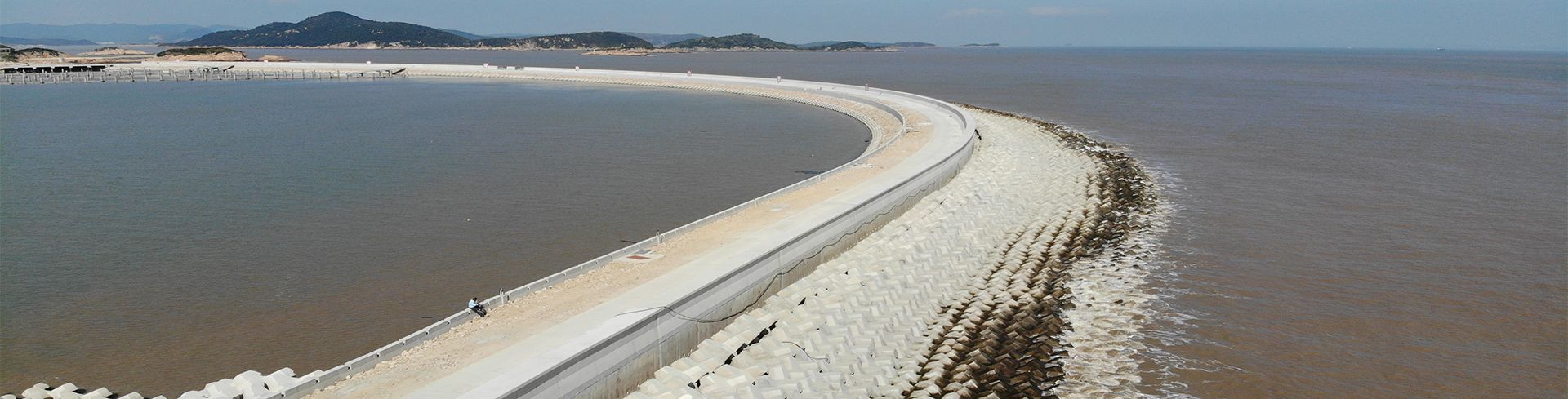
Accropode is a type of artificial armor block commonly used in coastal engineering. It is mainly applied to hydraulic structures such as breakwaters and shore protections. Its main function is to protect the core structure of breakwaters from wave action.On the one hand, it can avoid direct contact between breakwaters and waves, prevent breakwaters from being eroded by waves, and maintain structural stability.
On the other hand, it can dissipate wave energy on the slope, thereby reducing wave overtopping and improving the safety of structures behind the breakwater.
In practical engineering, five common layout methods of Accropode blocks include random layout, “positive & negative” regular layout, “queuing” regular layout, “staggered” regular layout, and mixed layout. A comparative analysis of these five layouts is presented below.
1.1 Random Layout(随机铺设)
The key indicator for assessing the placement quality of Accropode blocks is the number of blocks per unit area, which shall meet the design and specification requirements. Random placement of Accropode blocks adopts a fixed-point random arrangement: the slope surface is first divided into grids, and the grid node positions are determined by the formula: spacing × row spacing = design area / design density, so as to ensure the required placement density.
According to the 《Code of Design and Construction of Breakwaters》 , the requirements for random placement of Accropode blocks are as follows:
(1) Installation density, as the most important control index for Accropode blocks, shall comply with the relevant requirements of the code.
(2) As single-layer placed blocks, no Accropode shall protrude beyond the armor layer by more than 1/3 of its height, and each block shall be in full contact with the underlying cushion layer.
(3) Each block shall be in close contact with adjacent blocks. Blocks in the upper layer shall straddle between two blocks in the lower layer. Excessive offset is not allowed, nor is the upper block supported by only one lower block.
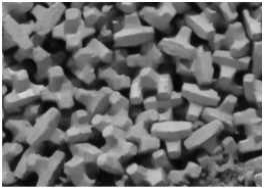
(4) Blocks shall be installed in the diamond layout as shown in the figure along the breakwater, and exceptions are only permitted in local areas.
(5) The gaps between blocks shall not be excessively large, so as to prevent the cushion stone from leaking out through the gaps.
(6) The orientation of blocks shall be varied; the same attitude shall be avoided as much as possible. The number of adjacent blocks with the same attitude shall not exceed three.
(7) All blocks shall be placed with three points in contact with the cushion layer; single-point or two-point contact is strictly prohibited.
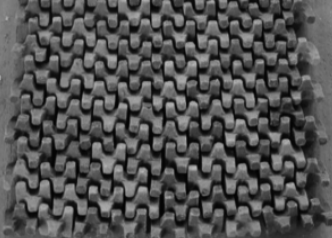
1.2 Positive & Negative Regular Layout(正反规则铺设)
The placement attitudes for the positive and negative regular layout shall comply with the following requirements:
(1) Three limbs shall be grounded at their ends, while the ends of the other three limbs shall face outward.
(2) The placement attitude of adjacent blocks shall not be the same; that is, blocks with one limb end facing seaward and those with two limb ends facing seaward shall be arranged alternately.
(3) Placement shall be carried out in strict accordance with interlocking blocks to ensure close contact between blocks and form an integral structure.
(4) Each block shall be in contact with the underlying cushion layer and shall not be suspended. The placement effect is shown in the figure.
1.3 Queued Regular Layout(队列式规则铺设)
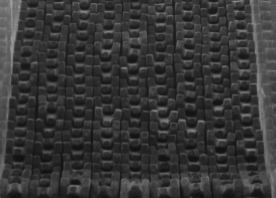
The placement attitudes for the queued regular layout shall comply with the following requirements:
(1) The ends of the three limbs of each block shall be guaranteed to be grounded.
(2) The placement attitude of adjacent blocks shall be the same; that is, one limb of each block shall be placed facing seaward.
(3) In the horizontal direction, the flanges of adjacent blocks shall be placed parallel to each other.
(4) The upper and lower adjacent blocks shall be in close contact to form an integral structure, and the placement effect is shown in the figure.
1.4 Staggered Regular Layout(交错式规则铺设)
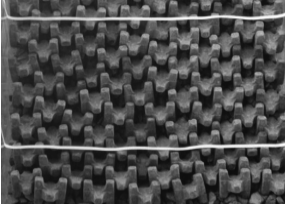
The placement attitudes for the staggered regular layout shall comply with the following requirements:
(1) Each block shall be placed obliquely on the slope to ensure that its three limbs are grounded at their ends.
(2) The placement attitude of adjacent blocks shall be the same; that is, one limb of each block shall be placed facing seaward.
(3) In the horizontal direction, there shall be a spacing equal to the width of one limb between adjacent blocks.
(4) The two limbs of each Accropode block in the rear row shall lean against the two limbs of the corresponding block in the front row respectively.
1.5 Mixed Layout(混合铺设)
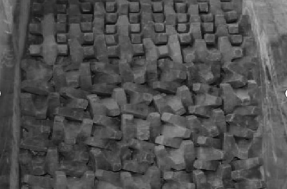
Slope protection shall be carried out by combining positive & negative regular placement and random placement. Random placement shall be adopted below the platform, while positive & negative regular placement shall be adopted above the platform. The placement attitude of blocks shall be determined in accordance with the requirements of positive & negative regular placement and random placement respectively. During the placement process, the placement quality of the junction between regular placement and random placement shall be guaranteed.
2. Applicable Conditions
2.1 Random Layout(随机铺设)
For random placement, it is only necessary to determine the grid node positions of Accropode blocks, and there are no strict requirements on their positioning attitude. Therefore, it is suitable for the construction of blocks both above water and underwater. The occlusion between blocks is relatively tight and stable.
2.2 Queued Regular Layout(队列式规则铺设)
The upper and lower rows of Accropode blocks in queued regular placement need to be well occluded. Therefore, in addition to determining their placement positions, their positioning attitudes must also be ensured. Underwater construction is more difficult, so it is generally suitable for above-water construction. The occlusion between blocks is closer than that of random placement, and the stability is better than that of random placement.
2.3 Positive & Negative Regular Layout(正反规则铺设)
The construction difficulty of positive & negative regular placement is greater than that of the previous two methods, because it requires the blocks to not only be occluded but also for the placement form of the upper and lower rows of blocks to be exactly the same. It is very difficult to carry out underwater construction. The blocks are mainly occluded with adjacent blocks in the upper and lower rows, so they have good stability.
2.4 Staggered Regular Layout(交错式规则铺设)
The gaps between blocks are concentrated, and the degree of mutual occlusion is slightly low. It is difficult to ensure the consistency of block attitudes during the placement process, and the blocks often overturn forward. Underwater construction is very difficult, and the stability is poor.
2.5 Mixed Layout(混合铺设)
The difficulty of its placement is between that of random placement and positive & negative regular placement, mainly because it is difficult to ensure the occlusion effect of blocks at the junction of regular and irregular placement. The stability is worse than that of single random placement and single positive & negative regular placement.
3. Test Results of Accropode in Different Placement Modes
(Excerpt from Key Laboratory of Coastal Disaster and Protection, Ministry of Education, College of Port, Coastal and Offshore Engineering, Hohai University)
Criteria for stability: According to the Wave Model Test Procedures, the criteria for slope protection blocks shall comply with the following provisions: (1) Under wave action, when the cumulative displacement of randomly placed protection blocks exceeds the maximum size of a single block, it becomes unstable; for large protection blocks where strength plays a controlling role, when the cumulative displacement exceeds half of the maximum geometric size of the block, it becomes unstable; (2) Under wave action, when the cumulative displacement of single-layer paved facing blocks exceeds the thickness of a single block, it becomes unstable. When the width of the gap generated by the displacement of single-layer randomly placed facing blocks exceeds half of the maximum geometric size of the block, it becomes unstable.
4. Conclusion
4.1 Degree of Construction Difficulty
Accropode blocks in random placement have no strict requirements on the placement attitude, so the construction difficulty is minimal, and it is suitable for underwater construction. Accropode blocks in regular placement have great difficulty in underwater construction and are generally suitable for above-water construction. The order of construction difficulty of the five placement methods from the most difficult to the easiest is: staggered type, queued type, positive & negative type, mixed type, and random placement.
4.2 Voidage Comparison
The voidage of the protection layer corresponding to random placement, queued placement, positive & negative placement and staggered placement are 0.5, 0.435, 0.404 and 0.5 respectively.
4.3 Occlusal Degree
The occlusal degree between Accropode blocks in positive & negative regular placement is the closest, followed by random placement, then queued placement, and staggered placement is the worst. For mixed placement, the occlusal degree between blocks at the junction of the two placement modes is worse than that of single random placement and single positive & negative regular placement.
4.4 Comparison of Stability
The order of stability of various placement modes from best to worst is: positive & negative regular placement, random placement, queued regular placement, mixed placement, and staggered regular placement. Staggered regular placement is not recommended for Accropode blocks.
4.5 Comparison of Wave Overtopping
The order of wave overtopping of several Accropode placement modes from largest to smallest is: positive & negative regular placement, queued regular placement, random placement, and staggered regular placement. There is little difference in wave overtopping between positive & negative regular placement and queued regular placement.


Ningbo Xiaolang Construction Engineering Co., Ltd.
Ningbo Tianyuan Cement Products Co., Ltd.
Yuehu Ginza, Nanzhan East Road, Haishu District, Ningbo City
+86 574 8698 8331
315012


Copyright © Ningbo Tianyuan Construction Engineering Co., LTD All Rights Reserved | Sitemap